JellyFil Official Website › Blog › What The Panel Leaves Blank
What The Panel Leaves Blank: Extract Form, Standardization And Species
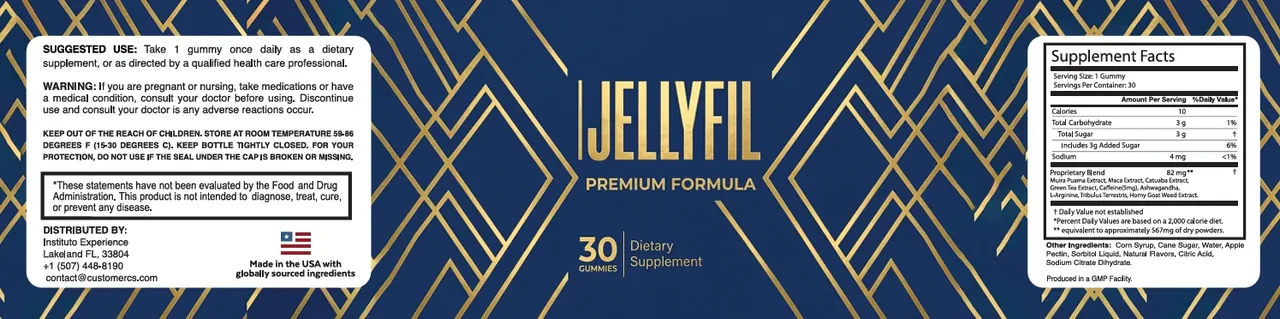
This bottle's own honest-limits box, printed on its Supplement Facts page, already admits two things most labels never say out loud: it does not state what standardisation any of its nine extracts carry, and it does not settle which species the word "catuaba" refers to on this particular bottle. Those two blanks are not unusual for this category. They are also not nothing, and this article works through what each one actually means and what the published science says about why they matter.
The two blanks this panel names itself
The JellyFil Supplement Facts page carries a section titled "What the JellyFil panel does and does not settle," split into what the printed panel establishes and what it leaves open. Among the items in the second list: "What standardisation each extract carries" and "Which species the word catuaba refers to on this bottle." Both are printed by the same website that sells the product, which is worth noting before anything else in this article: these are not gaps an outside critic found. They are gaps this website's own label page already states plainly.
That does not make either blank harmless to skip past. It makes them worth explaining in full, which the panel's own honest-limits box does not have room to do.
What "standardisation" actually means
A plant extract is not one fixed thing. The same species, harvested at different times, from different growing conditions, processed with different solvents and different ratios of raw plant material to finished extract, can end up chemically different from one bottle to the next, sometimes by a wide margin. Standardisation is the industry's answer to that problem: a manufacturer picks one or more marker compounds believed to matter — withanolides in ashwagandha, icariin in horny goat weed, EGCG in green tea — and guarantees the extract contains at least a stated percentage of that marker, batch to batch.
When a label states a standardisation figure, a reader can compare it directly to whatever a published trial used. This website's own article on who should not take this product shows exactly how useful that comparison is: the ashwagandha trials it cites used an extract standardised to a stated 21 mg of withanolide glycosides a day, or a 600 mg dose of root extract with its own separate specification. Either number lets a reader ask a specific, answerable question about a specific product.
This bottle's panel does not offer that number for any of its nine plants. It states "Muira Puama Extract," "Maca Extract," "Ashwagandha," and so on, with an amount of "inside the 82 mg total" and nothing about extraction ratio, solvent, or marker-compound content.
Why a blend total leaves it blank almost by design
US labelling rules do not require a standardisation figure on a supplement panel at all, standardised or not, and a proprietary blend format makes it especially easy to leave out. Under 21 CFR 101.36, a manufacturer may state one combined weight for a blend, list its contents in descending order, and stop there. Nothing in that rule asks for a standardisation percentage, an extraction ratio, or a plant-to-extract yield, for the blend as a whole or for any single ingredient inside it. This website's dose arithmetic article covers what the blend-total format costs a reader on the question of amount. This article is about the parallel cost on the question of form: two products could both say "Ashwagandha, inside an 82 mg blend" while containing extracts that differ several-fold in the compounds a published trial actually measured, and a reader would have no way to tell them apart from the label alone.
Settled by this panel: the plant is present, its name and its Latin binomial where one is given, and its rank by weight against the other eight. Unsettled: how it was extracted, to what ratio, and whether it was standardised to any particular compound at all. The rule that permits a single blend total does not require either the manufacturer or this website to fill that second gap, and neither has.
The catuaba question, specifically
Catuaba is a Portuguese trade name used in Brazilian herbal medicine, and it is where the standardisation gap turns into something slightly different: a naming gap. This bottle's panel states "Catuaba Extract (Trichilia catigua)," giving a specific Latin binomial alongside the common name. That is more precision than many labels in this category offer.
The complication is that "catuaba" has never referred to one single, universally agreed plant. Depending on region and supplier, the name has historically been applied to bark from several unrelated plant families, including species in the genus Erythroxylum — the same genus as the coca plant, though not the same species — as well as Trichilia catigua and other Meliaceae relatives. Different plants, different families, one shared market name. That is exactly the kind of naming ambiguity the honest-limits box on this website's own label page is flagging when it lists "which species the word catuaba refers to on this bottle" as unsettled: printing a Latin binomial on a label states what the manufacturer says is inside. It is not, on its own, the same thing as an independent chemical test confirming it.
What the Trichilia catigua research actually studied
Setting the naming question aside, Trichilia catigua specifically — the species this label names — does have its own published pharmacology, and it is worth being exact about what it covers.
A 2018 laboratory and animal study compared four different extracts of Trichilia catigua bark, made with different solvents, and tested them for antioxidant activity, for inhibition of the enzyme acetylcholinesterase, and for effects on fatigue in mice and rats. The hydroalcoholic extract was the most active of the four in the lab assays. In the animal studies, that same extract did not protect rats from cold-immobilisation stress and did not prevent memory impairment in a standard mouse model, but it did partially reduce the fatigue caused by forced treadmill exercise, at oral doses of 25 to 300 mg per kilogram of body weight.
| What was tested | Result |
|---|---|
| Antioxidant activity, four solvent extracts | Present in all four; strongest in the hydroalcoholic extract |
| Acetylcholinesterase inhibition | Present, strongest in the hydroalcoholic extract |
| Cold-immobilisation stress, rats | Not protected |
| Scopolamine-induced memory impairment, mice | Not prevented |
| Treadmill-induced fatigue, mice | Partially reduced at the highest dose tested |
Martins NO, de Brito IM, Araujo SSO, et al. BMC Complement Altern Med. 2018. Animal and laboratory work; no human trial of Trichilia catigua for any of these outcomes has been published.
None of that is a claim about libido or sexual function specifically, and none of it is a human trial. It is laboratory and animal evidence for antioxidant, anticholinesterase and antifatigue activity in the species this label names, at doses expressed in milligrams per kilogram of animal bodyweight rather than in any figure that scales to a human serving of a shared 82 mg blend.
How common a gap this is across the category
Both blanks on this panel — standardisation and species certainty — sit inside a documented, industry-wide problem rather than something specific to this one bottle. A 2021 review of chemical authentication methods examined 2,386 commercial herbal products sold across 37 countries. Across the full dataset, 27 percent of products showed some form of adulteration when chemically tested against their label claims: total absence of a labelled ingredient, substitution with a related or unrelated species, filler material standing in for the named botanical, or hidden ingredients the label never mentioned. Adulteration rates varied by country, from 21 percent in the largest China-sourced sample to 37 percent in the United Kingdom sample, with the United States sample at 27 percent.
A separate, more recent 2023 review looked specifically at mass-spectrometry methods for checking botanical authenticity in dietary supplements, and reaches a similar conclusion from a different angle: chemical testing is necessary precisely because label claims and actual botanical content diverge often enough, across the wider herbal supplement market, that visual inspection or trust in a printed name is not sufficient on its own.
- More than a quarter of commercial herbal products tested, across a large multi-country dataset, showed some form of botanical adulteration.
- Species substitution, filler material and undeclared ingredients were all documented.
- This is a category-wide pattern the literature has been tracking for years, not an allegation about this specific product.
- Neither review tested JellyFil, and this website has not independently chemically tested this bottle's catuaba extract against the printed binomial.
What a reader can and cannot check from home
A reader holding this bottle can check the printed panel against what this website reproduces on the supplement facts page, can look up any plant name against its own published trials the way every article on this blog does, and can compare the blend total against trial doses the way that companion article sets out. What a reader cannot do from home is confirm, without a laboratory, that the catuaba inside a specific bottle is chemically Trichilia catigua rather than a related or unrelated plant sold under the same common name, or confirm what standardisation, if any, was applied to any of the nine extracts before they went into the blend.
That is not a gap this website can close by writing around it, and it is not being presented as one here. It is a limit of what a printed panel, on this bottle or on most others in this category, actually proves.
Reading the blanks fairly
Two things are true at once. First, this label states more than many in its category: a full nine-plant list in descending order, a Latin binomial for most of the named plants, and a blend total and per-serving caffeine figure that the format does not strictly require. Second, it still leaves both standardisation and species certainty unstated, exactly as its own honest-limits box already says, and the wider herbal-supplement literature gives a reader good reason to treat "the label names it" and "an independent test confirmed it" as two different levels of confidence rather than one.
Nothing here is a claim that this specific bottle is mislabelled. It is a claim that the panel does not, and structurally cannot, settle the question on its own, and that a reader who wants the standardisation or authentication question closed needs a source beyond the printed panel to close it.
Every plant on the JellyFil panel is covered on this website
Including what the label states, what it leaves open, and what the published research on each plant does and does not establish.
From $158 for two bottles to $294 for six, with 60 days on all three
Order JellyFilChewed, one a day, 30 to a bottle.
JellyFil is a dietary supplement, not a treatment for anything. None of the authentication research cited on this page tested this specific product, and this website has not independently laboratory-tested this bottle's contents against its printed panel. The FDA's dietary supplements pages publish background on how botanical supplements are regulated and what their labels are and are not required to prove.
Further reading on this website: what eighty-two milligrams buys, on the amount side of this same labelling format; nine on the bottle, six in the advert, on the gap between the panel and the advertising; and the testing & quality page, on what this bottle's badges do and do not certify.
References
- Ichim MC, Booker A. Chemical Authentication of Botanical Ingredients: A Review of Commercial Herbal Products. Front Pharmacol. 2021;12:666850. Chemical authentication of 2,386 commercial herbal products across 37 countries; 27% showed some form of adulteration, including species substitution and undeclared ingredients. PMID 33935790. https://pubmed.ncbi.nlm.nih.gov/33935790/
- Grazina L, Mafra I, Monaci L, Amaral JS. Mass spectrometry-based approaches to assess the botanical authenticity of dietary supplements. Compr Rev Food Sci Food Saf. 2023;22(5):3870-3909. Review of analytical methods for checking whether a supplement's actual botanical content matches its label. PMID 37548598. https://pubmed.ncbi.nlm.nih.gov/37548598/
- Martins NO, de Brito IM, Araujo SSO, Negri G, Carlini EA, Mendes FR. Antioxidant, anticholinesterase and antifatigue effects of Trichilia catigua (catuaba). BMC Complement Altern Med. 2018;18(1):172. Laboratory and animal study of four Trichilia catigua bark extracts; hydroalcoholic extract most active, partially reduced exercise-induced fatigue in mice at 25-300 mg/kg. PMID 29866157. https://pubmed.ncbi.nlm.nih.gov/29866157/
- 21 CFR 101.36, Nutrition labeling of dietary supplements. US Government Publishing Office. The rule allowing one stated total for a proprietary blend, listed in descending order of weight, with no standardisation figure required. https://www.govinfo.gov/content/pkg/CFR-2023-title21-vol2/xml/CFR-2023-title21-vol2-sec101-36.xml