JellyFil Official Website › Blog › What Eighty-Two Milligrams Buys
JellyFil Dosage: What 82 mg Contains, Totals vs Trial Doses
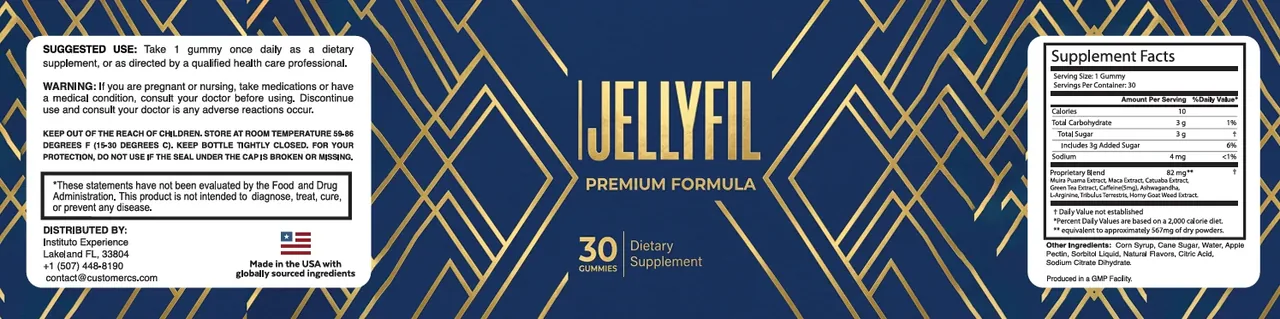
The JellyFil dosage is an 82 mg proprietary blend per gummy. A blend keeps the single amounts private but publishes the total, and that total works as a ceiling for every plant inside it. This guide sets that ceiling next to the doses used in published trials, so a buyer can judge the blend with plain arithmetic.
What a blend total actually tells you
A proprietary blend is a legal labelling format. Under the federal rule a manufacturer may declare a blend as one total weight and list its contents in descending order of weight, without stating an amount for each. The stated reason is commercial confidentiality: a competitor reading a full breakdown could copy the formula.
What that costs a buyer is specific. It is not that the ingredients are secret — they are all printed. It is that no single ingredient can be set against any single trial, because the trial has a number and the label does not.
Two things survive, and both are more useful than they look. The order is a real ranking by weight, so the first name genuinely outweighs the last. And the total is a hard ceiling on every name inside it.
The ceiling argument
This is the part most people skip, and it is the part that does the work.
If a blend totals eighty-two milligrams and holds nine plants, then no plant in it is present at more than eighty-two milligrams. That is not an estimate and it does not depend on knowing the recipe. It is arithmetic, and it holds no matter how the manufacturer split the total.
In practice the ceiling is much lower than the total for eight of the nine, because they share the space. The first name by weight might be a third of the blend; the last might be a fraction of a milligram. Nobody outside the factory knows the split, and nobody needs to, because the ceiling is enough to answer the only question that matters.
Is the amount the trials used larger than the entire blend? If it is, no share of that blend can reproduce the trial, and no amount of argument about the split changes that.
What the trials behind these plants actually used
Here is the comparison, with the doses read out of the abstracts rather than recalled. Every figure in the right-hand column is what a published trial gave people, not an amount in any gummy.
| Plant | What the published trial gave | Against a blend of 82 mg |
|---|---|---|
| Maca | 1,500 to 3,000 mg a day for 12 weeks | 18 to 37 times the whole blend |
| L-arginine | 5,000 mg a day for 6 weeks | 61 times the whole blend |
| Tribulus terrestris | 770 mg a day for 6 weeks | 9 times the whole blend |
| Green tea catechin | about 800 mg of EGCG a day | 10 times the whole blend |
| Caffeine | 3 to 6 mg per kg of bodyweight | 3 to 6 times the whole blend for an average adult |
| Ashwagandha | 21 mg of withanolide glycosides a day | the one figure smaller than the blend total |
The right-hand column compares each trial dose with the ENTIRE blend, not with that plant's share of it. The real gap per plant is larger, by an unknown factor.
The twelve-week maca trial gave 1,500 or 3,000 mg a day and recorded a rise in self-rated desire from week eight. The arginine trial gave five grams a day for six weeks and found subjective improvement in nine of twenty-nine men, with no change in the measured blood flow. The tribulus trial gave 770 mg a day for six weeks.
One row runs the other way and it is worth dwelling on. The ashwagandha crossover trial used a standardised extract delivering just twenty-one milligrams of withanolide glycosides a day, which is smaller than this blend's total. That is what a standardised extract buys: the active fraction is concentrated, so the milligram figure falls. Nothing on this panel says whether the ashwagandha in it is standardised or to what, so the comparison cannot be completed. It is still the one row where the arithmetic does not immediately settle the question.
The footnote that changes the picture
Under the blend line the panel carries a second statement: the eighty-two milligrams is equivalent to approximately five hundred and sixty-seven milligrams of dry powders.
That is the manufacturer saying the blend is made from concentrated extracts, and that the raw plant material behind them would weigh about seven times as much. It is a legitimate thing to state and it genuinely improves the picture: a comparison against 567 mg is more generous than one against 82 mg.
It does not resolve anything. Five hundred and sixty-seven milligrams shared across nine plants is still far below 1,500 mg of maca or 5,000 mg of arginine, and the extract ratios for individual plants are not stated, so the conversion cannot be applied per name.
- The 82 mg figure is the weight in the gummy.
- The 567 mg figure is the manufacturer's stated dry-powder equivalent.
- Neither figure is broken down by plant, so neither can be set against a single trial.
- Both are ceilings, and both are below the doses in the table above.
- An extract can be more potent per milligram than raw powder, which is the whole point of extracting, and none of the ratios are published here.
Why a manufacturer uses a blend at all
It is worth steelmanning the format, because the argument for it is not nothing and a reader who dismisses every blend out of hand will dismiss some decent products.
The stated reason is commercial confidentiality. Developing a formula costs money, the ratio between ingredients is where whatever expertise exists actually sits, and a full breakdown is a recipe a competitor can copy for the price of a bottle. A manufacturer that publishes everything is subsidising the manufacturer that publishes nothing.
There is a second reason that is rarely stated and is probably more common. A blend lets a formula include a small amount of an expensive ingredient for the sake of naming it, without the buyer being able to see how small. That practice has a name in the trade and it is not a flattering one.
Both reasons produce the same label. Nothing on a panel distinguishes a genuinely proprietary ratio from a decorative sprinkle, which is exactly why the ceiling argument matters: it is the only test a buyer can run from outside.
| The argument for a blend | What it does not answer |
|---|---|
| A competitor could copy a published breakdown | Why the total itself could not be larger |
| The ratio is where the formulation work is | Whether any ingredient is present in a useful amount |
| Extract potency varies, so raw milligrams mislead | Why the extract ratio is not published either |
| Everything IS listed, just not quantified | How a buyer compares two blends of different totals |
The left column is the case a manufacturer would make. The right column is what a buyer is left holding, and it is the reason this article is about the total rather than about the split.
The fair position, and the one this desk takes: a proprietary blend is a legitimate commercial choice and it is also a cost passed to the reader. A product that uses one is asking to be trusted on a point it has chosen not to evidence. Whether that is reasonable depends entirely on the size of the total, which is the one number it did publish.
The JellyFil panel is printed here in full
Both figures, the nine names in weight order, the caffeine and the added sugar. The arithmetic above is done on the page rather than left for the reader.
From $158 for two bottles to $294 for six, with 60 days on all three
Choose A JellyFil PackChewed, one a day, 30 to a bottle. Batch JEL-26/JE-5655, shipped from the United States.
What honestly follows from this
Two conclusions, and they point in different directions, which is why both are worth printing.
The first is that nobody should buy a blend of this size expecting the effect sizes in the trials behind its ingredient names. The arithmetic does not allow it. A page that quotes a maca trial and then sells you eighty-two milligrams of nine-plant blend is inviting an inference the numbers do not support.
The second is that this is not a reason to dismiss the product, because the category audit found the same situation across the thirty-two best-selling men's formulas on sale: no finished product with a trial of its own, and most ingredients at amounts nobody could reconcile with the literature. This bottle is ordinary in that respect and unusually honest in another, because it prints its panel in full.
What a buyer is actually choosing, then, is a daily routine with a refund window attached, on a label they can read. That is a smaller proposition than the marketing makes, and it is a real one.
How to use this when buying anything
The method is four lines and it works on any bottle in any category.
- Find the blend total. It is the number immediately after the words proprietary blend.
- Pick the ingredient the marketing leans on hardest. That is the claim being sold.
- Look up one trial of that ingredient and write down the daily dose it used. A single well-known trial is enough for this purpose.
- Compare the trial dose with the whole blend total. If the trial dose is larger, the product cannot deliver it, and every subsequent argument about ratios and bioavailability is a distraction from that.
- A blend total is a ceiling on every ingredient inside it.
- This blend is 82 mg, with a stated dry-powder equivalent of about 567 mg.
- The maca trials used 1,500 to 3,000 mg and the arginine trial used 5,000 mg a day.
- One row runs the other way: a standardised ashwagandha extract at 21 mg a day.
- Buy the routine and the window, not the effect sizes in somebody else's trial.
JellyFil is a dietary supplement, not a treatment for anything. Erectile difficulty that arrived quickly, or that has worsened month by month, is treated in the cardiology consensus on the subject as a cardiovascular marker worth assessing rather than a standalone complaint, because the vessels involved are small and show a problem before larger ones do. MedlinePlus sets out plainly what a clinician will look at. That is an appointment, and no gummy is a substitute for it.
Further reading on this website: the dosage analysis on the home page, which is this arithmetic applied section by section; the ingredient pages with every trial dose; and the panel itself.
References
- 21 CFR 101.36, Nutrition labeling of dietary supplements. US Government Publishing Office. The rule that lets a label state one total for a proprietary blend and list its contents in descending order of weight without an amount for each. https://www.govinfo.gov/content/pkg/CFR-2023-title21-vol2/xml/CFR-2023-title21-vol2-sec101-36.xml
- Gonzales GF, Cordova A, Vega K, et al. Effect of Lepidium meyenii (MACA) on sexual desire and its absent relationship with serum testosterone levels in adult healthy men. Andrologia. 2002;34(6):367-72. Men aged 21-56 took 1,500 mg or 3,000 mg a day for twelve weeks; self-reported desire improved from week eight and testosterone did not move. PMID 12472620. https://pubmed.ncbi.nlm.nih.gov/12472620/
- Chen J, Wollman Y, Chernichovsky T, et al. Effect of oral administration of high-dose nitric oxide donor L-arginine in men with organic erectile dysfunction: results of a double-blind, randomized, placebo-controlled study. BJU Int. 1999;83(3):269-73. Fifty men, 5 g a day for six weeks; nine of twenty-nine reported subjective improvement, all of them men who started with low nitric oxide excretion, and the measured haemodynamics did not change. PMID 10233492. https://pubmed.ncbi.nlm.nih.gov/10233492/
- Fernandez-Lazaro D, Mielgo-Ayuso J, Del Valle Soto M, et al. The Effects of 6 Weeks of Tribulus terrestris L. Supplementation on Body Composition, Hormonal Response, Perceived Exertion, and CrossFit Performance: A Randomized, Single-Blind, Placebo-Controlled Study. Nutrients. 2021;13(11):3969. Thirty trained men, 770 mg a day for six weeks. PMID 34836225. https://pubmed.ncbi.nlm.nih.gov/34836225/
- Lopresti AL, Drummond PD, Smith SJ. A Randomized, Double-Blind, Placebo-Controlled, Crossover Study Examining the Hormonal and Vitality Effects of Ashwagandha (Withania somnifera) in Aging, Overweight Males. Am J Mens Health. 2019;13(2):1557988319835985. A standardised extract delivering 21 mg of withanolide glycosides a day for eight weeks; testosterone rose 14.7% more than placebo, while fatigue, vigour and sexual well-being showed no between-group difference. PMID 30854916. https://pubmed.ncbi.nlm.nih.gov/30854916/
- Kuchakulla M, Narasimman M, Soni Y, et al. A systematic review and evidence-based analysis of ingredients in popular male testosterone and erectile dysfunction supplements. Int J Impot Res. 2021;33(3):311-317. Thirty-seven ingredients across the thirty-two best-selling products; no finished product had a published trial of its own, and 68% of ingredients scored C or D for contradictory, negative or absent evidence. PMID 32358510. https://pubmed.ncbi.nlm.nih.gov/32358510/