Sleep Quality and Erection Quality: The Real Link
Does sleep really affect erections and testosterone?
Yes. Most of a man's daily testosterone is released during sleep, so short or broken sleep measurably lowers it, and it strains the blood-flow and nervous systems that erections depend on. Fixing sleep is one of the most reliable, no-cost levers for drive, morning erections and steady daytime energy.
- The mechanism: deep and REM sleep drive most overnight testosterone release.
- The evidence: a week at ~5 hours a night cut young men's daytime testosterone 10–15%.
- The red flag: loud snoring and daytime exhaustion can signal sleep apnea, which is tied to low T and ED.

Your biggest testosterone factory runs at night
It is easy to think of testosterone as something your body tops up steadily around the clock. It does not work that way. Testosterone production follows a strong daily rhythm, and the bulk of it is released while you sleep, peaking in the early-morning hours during deep and REM stages. That is why a healthy man's levels are highest just as he wakes and drift lower through the day.
The practical implication is blunt: if you routinely cut your night short, or if your sleep is broken into shallow fragments, you are interfering with the single window in which most of that hormone is made. You cannot fully make it up with a good breakfast, a strong coffee, or a hard workout. The factory keeps its own hours, and those hours are while you are unconscious.
Sleep is not the recovery you do after the important stuff. For your hormones, it is the important stuff.
What happens to testosterone when sleep gets short
The most quoted piece of evidence here is a tightly controlled study of the effect of one week of sleep restriction on testosterone levels in young healthy men. After a week of sleeping only about five hours a night — the kind of schedule millions of men treat as normal during a busy stretch — their daytime testosterone dropped by roughly 10 to 15 percent. To put that in perspective, testosterone normally falls around 1 to 2 percent per year with age, so a single hard week of short sleep can undo years of the natural decline, in the wrong direction.
The men in that study also reported lower daytime energy and vigour as the week went on, which is exactly what you would expect when the hormone that underpins drive is being suppressed. The reassuring part is that this kind of decline is largely reversible: catch up on consistent, full-length sleep and the overnight production window reopens. The damage comes from making short sleep a lifestyle rather than an occasional exception.
Nocturnal erections: a plumbing check, not a testosterone gauge
Healthy men experience several erections during sleep, mostly during REM, and often wake with one. It is tempting to read morning erections as a direct testosterone readout, but that is not quite what they measure. Nocturnal erections are better understood as an overnight test of the vascular and nervous plumbing: they show that blood flow, nerve signalling and the erectile tissue itself are working when the conscious brain, and its performance anxiety, is offline.
That distinction matters. If morning erections disappear entirely, it is worth paying attention — it can point to a circulatory or nerve issue rather than a purely psychological one, and it is a reasonable thing to raise with a doctor. But their day-to-day presence or firmness is not a home testosterone meter. Treat them as a signal about your hardware and your sleep quality, not as a number to obsess over.
Sleep apnea: the link most men miss
If there is one sleep problem that deserves a spotlight in any honest conversation about male performance, it is obstructive sleep apnea. In apnea, the airway collapses repeatedly through the night, jolting you out of deep sleep — sometimes dozens of times an hour — usually without you remembering any of it. The result is fragmented sleep that never reaches the restorative depth where hormones are released.
A systematic review and meta-analysis of the association between obstructive sleep apnoea and erectile dysfunction links untreated sleep apnea with a markedly higher rate of erectile difficulty, and the research ties it to lower testosterone too. It makes sense mechanistically: you lose the deep-sleep hormone window, you spend the night in a low-oxygen, high-stress state, and you wake exhausted with elevated cortisol. The classic signs are loud snoring, gasping or choking at night, waking unrefreshed no matter how long you were in bed, and heavy daytime sleepiness. If several of those describe you, a sleep study is one of the highest-value health steps you can take — for your energy, your heart and your performance alike. This is general information, not a diagnosis.
How much sleep, really
For most adult men the target is seven to nine hours a night, and the hormonal benefit tracks with hitting that range consistently rather than banking a deficit all week and bingeing on the weekend. A few levers move the needle more than people expect:
- Keep the schedule regular. Going to bed and waking at similar times stabilises the rhythm that governs overnight testosterone release.
- Protect the deep stages. Late alcohol, big late meals and a hot bedroom all fragment deep sleep even when total hours look fine.
- Cut the light and the screens before bed. Bright evening light delays the wind-down and pushes back the whole cycle.
- Manage the stress load. A racing, cortisol-fuelled mind is one of the most common reasons men lie awake, which loops straight back to hormones.
Where a supplement fits — and where it doesn't
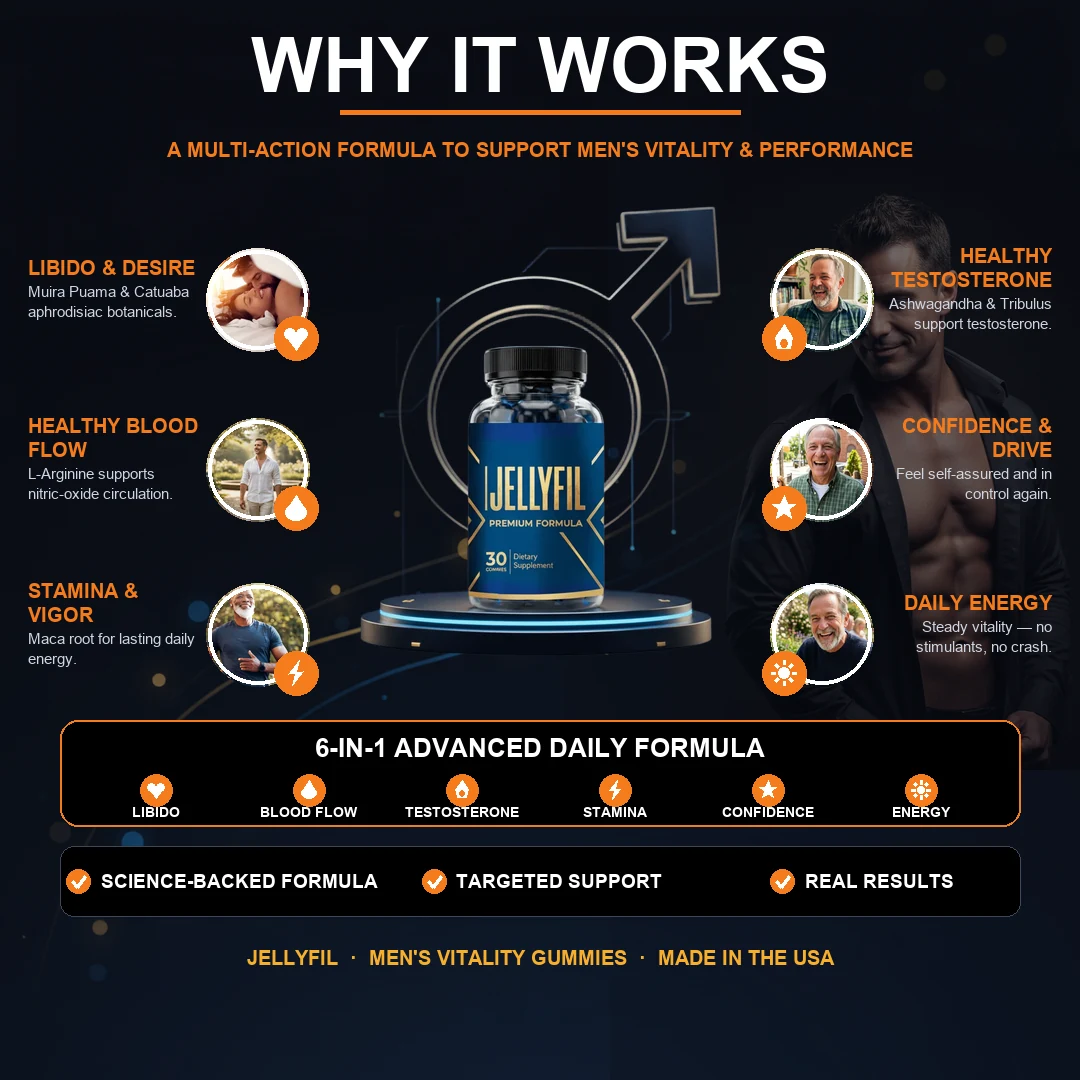
No gummy will out-run a chronic sleep debt, and any honest brand should say so. Sleep is the foundation; a supplement is, at most, support around the edges. Where a formula like JellyFil is relevant is the stress side of the equation. Its ashwagandha is included specifically because human trials link it to lower cortisol, and high night-time cortisol is one of the classic reasons men struggle to fall and stay asleep. Lower the stress load and, for some men, the wind-down gets easier.
The rest of the JellyFil blend targets the other systems this article touched on: L-Arginine supports the nitric-oxide pathway behind blood flow, while Maca and Tribulus sit on the energy and testosterone side. None of that replaces a full night of sleep — it works alongside it. If you want the wider view on whether this category earns its place at all, read our honest guide to male-enhancement gummies. Fix the sleep first; let the supplement be the smaller lever, not the main one.
Related reading
- Kegel Exercises for Erection Strength in Men
- Belly Fat and Testosterone in Men
- Performance Anxiety: Natural Support for Men
- KSM-66 Ashwagandha: What to Look For

Sleep first. Support the rest.
JellyFil pairs cortisol-supporting ashwagandha with blood-flow and testosterone actives — every ingredient named on the label, with today's official-store pricing and a 60-day guarantee.
Order NowFrequently asked questions
How does sleep affect testosterone?
Most of your daily testosterone is produced during sleep, with the biggest release tied to deep and REM stages in the early-morning hours. When you cut sleep short or fragment it, that production window shrinks. In one well-known study, restricting healthy young men to about five hours a night for a week lowered their daytime testosterone by roughly 10 to 15 percent.
Can poor sleep cause erectile problems?
Poor sleep rarely acts alone, but it stacks the deck against you. It lowers testosterone, raises the stress hormone cortisol, and strains the blood vessels and nerves that erections rely on. Chronically short or broken sleep is consistently linked with weaker morning erections and lower desire, and improving sleep is one of the first lifestyle changes worth making.
Does sleep apnea lower testosterone?
Yes, it is strongly associated with it. Obstructive sleep apnea repeatedly interrupts breathing and wrecks the deep sleep your body needs for hormone release, and men with untreated apnea often show lower testosterone and a higher rate of erection problems. If you snore heavily, wake unrefreshed, or feel exhausted by day, ask a doctor about testing.
How many hours of sleep do men need for hormones?
Most adults need seven to nine hours a night, and the hormone benefits track with hitting that range consistently rather than catching up on weekends. Quality matters as much as quantity, so protecting uninterrupted deep sleep, keeping a regular schedule, and limiting late alcohol and screens all help the overnight testosterone cycle do its job.
References
- Leproult R et al. Effect of 1 week of sleep restriction on testosterone levels in young healthy men. JAMA. 2011. PMID: 21632481.
- Pang KH et al. The association between obstructive sleep apnoea and erectile dysfunction: a systematic review and meta-analysis. Int J Impot Res. 2026. PMID: 42410062.
- National Heart, Lung, and Blood Institute — Sleep Deprivation and Deficiency.
- Centers for Disease Control and Prevention — About Sleep.