JellyFil Official Website › Blog › A Gummy Is A Format Decision
JellyFil Gummies: Is a Chewable Format Right for You?
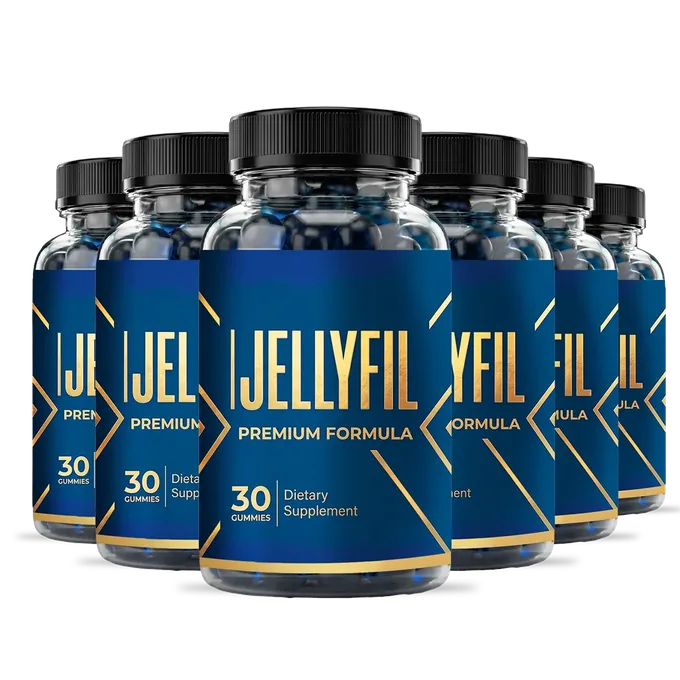
JellyFil gummies are a chewable, which means there is no capsule or liquid version to pick from. The label says one gummy once daily, and a bottle holds 30, enough for a month. Each gummy has an 82 mg blend of nine ingredients, 3 g of added sugar and 10 calories, set with apple pectin instead of gelatin.
Why gummies took over a shelf
Walk a supplement aisle now and the chewables have taken a share that would have been unimaginable fifteen years ago. The reason is not that they work better. It is that they get taken.
Everybody who has bought supplements has a drawer with a half-finished bottle of capsules in it. The capsules were fine. The routine failed. A format that turns a daily obligation into something closer to a sweet solves a behavioural problem, and behavioural problems are what actually decide outcomes in this category.
That is the honest case for a gummy and it is a good one. It is also the whole case, and the rest of this article is about what it costs.
What the format buys
- Adherence. A bottle of gummies gets finished. A bottle of capsules bought for the same reason often does not.
- No swallowing. For a meaningful number of adults, swallowing capsules is genuinely unpleasant, and that alone ends most supplement routines.
- No water, no timing, no meal rule. A chewable can be taken standing at a kitchen counter with car keys in the other hand.
- A visible habit. A bottle on the counter is a reminder; one in a cupboard is not.
None of those is pharmacology and all of them are real. The audit of the best-selling men's formulas found no finished product in the category with a trial of its own, which means the difference between two products on this shelf is rarely the formula. Quite often it is whether the bottle gets emptied.
What the format costs
Three things, in order of how often they are mentioned, which is the reverse of how much they matter.
| The cost | How much it matters | Why |
|---|---|---|
| Added sugar | A little | 3 g a serving and 10 calories. Real, small, and the only one the marketing never mentions. |
| Payload space | A lot | A gummy is mostly setting agents and sweetener. What is left for actives is measured in tens of milligrams. |
| Perceived seriousness | Depends on the buyer | A sweet is harder to take seriously than a capsule, which cuts both ways. |
| Heat sensitivity | A little | The label asks for 59 to 86 degrees Fahrenheit. Warm storage makes gummies stick together. |
| Cost per milligram of active | A lot | You are paying for the confection as well as for the blend. |
The two rows marked A lot are the ones this website's dosage analysis is built around, and they are structural rather than specific to any brand.
The sugar, in proportion
Three grams of added sugar a serving. Ten calories. Six per cent of the Daily Value for added sugar.
For most adults that is genuinely negligible. A single square of chocolate carries more. The consumer background on sugars is worth a glance if you are counting, and for anyone managing blood sugar it is a line on the panel rather than a footnote — but it is not the reason to choose or reject a product.
What is worth noticing is that the marketing never mentions it. A gummy is sold on being easy, and the ingredient that makes it easy is the one absent from the copy. That is the same pattern as the ingredient count, and it is the reason this website prints the panel in full.
Three grams of added sugar a day is about 6% of the Daily Value. Reject a gummy for that and you should reject a good deal else first. Just do not let a marketing page be the reason you did not know.
The space problem nobody mentions
This is the structural cost and it is the one that decides what a chewable can contain.
A gummy has to be a gummy. It needs a gelling agent, a sweetener, water, an acid, a buffer and a flavour, and those occupy most of its weight. What remains for active ingredients is small — on this bottle, eighty-two milligrams of blend across nine plants, with a stated dry-powder equivalent of about five hundred and sixty-seven milligrams.
A capsule does not have that problem to the same degree. A size-00 capsule holds several hundred milligrams of powder and nothing else, and a tablet can be pressed to a gram or more.
So the trade is real and it is the central trade of the format. A gummy buys the routine and spends the payload; a capsule buys the payload and risks the routine. Neither choice is wrong and both should be made knowingly.
- A chewable's weight is mostly confection, so the active payload is measured in tens of milligrams.
- A proprietary blend is permitted to publish one total, which makes that payload harder to compare across products.
- An extract concentrates the active fraction, which is why extract milligrams and raw-powder milligrams are not the same currency.
- Anything with a genuine gram-scale dose — a protein, a creatine, a citrulline — is not going to arrive in a single gummy, whatever format the marketing prefers.
- Anything with a real safety ceiling is worth checking on a panel regardless of format; green tea extract is the example on this particular bottle.
What to check on any chewable panel
A chewable panel has three lines a capsule panel does not, and they are the three worth reading first.
The sugar line, and whether it is added
Total sugar and added sugar are different declarations. A gummy sweetened with cane sugar and corn syrup will show the two as the same number, which is what this bottle does at three grams. A gummy using a sugar alcohol will show a smaller added-sugar figure and a different set of digestive considerations at higher servings.
The setting agent on the other-ingredients line
Pectin or gelatin. It decides whether the vegetarian mark on the front is supportable, and it is the single fastest way to check a front-of-bottle claim against the back. This bottle uses apple pectin, which is consistent with the roundel it prints.
The serving size, which is not always one
Plenty of chewables in this category set a serving at two gummies or three, which doubles or triples the sugar and halves the apparent price per serving on a shelf. A bottle of sixty at two a day is a month, not two months. This one is one gummy and thirty to a bottle, so the arithmetic is unusually simple.
- Check whether the serving is one gummy or more before comparing any price.
- Read added sugar rather than total sugar; they are separate lines for a reason.
- Find the setting agent, because it validates or contradicts the front label.
- Look for a stimulant inside the blend, which a chewable is the last place you would expect one.
- Note the blend total, which in a chewable will be smaller than in a capsule from the same brand.
The JellyFil panel says what the format costs
Three grams of added sugar, ten calories, five milligrams of caffeine and an 82 mg blend, all printed on the bottle and all reproduced on this website.
From $158 for two bottles to $294 for six, with 60 days on all three
Choose A JellyFil PackChewed, one a day, 30 to a bottle. Batch JEL-26/JE-5655, shipped from the United States.
Choosing between a gummy and a capsule
Four questions, and the first one settles it for most people.
- Have you finished your last two bottles of capsules? If the answer is no, the format question is already answered and the payload argument is theoretical.
- Is the active you care about a gram-scale ingredient? If it is, no chewable will deliver it and a powder or a capsule is the only honest option.
- Are you counting sugar for a medical reason? If so, three grams a day is a line to discuss rather than to ignore.
- Does the product print its full panel? This one is format-independent and it matters more than the other three. The general guidance on using supplements sensibly comes back to the same point.
And a note on the caffeine, since the format hides it. Five milligrams is trivial by any measure, but it is a stimulant in a sweet, and the consumer page on caffeine is the right reference if you are already at the edge of your tolerance. The reason to mention it here is not the dose. It is that a chewable is the last place most people would think to look for one.
- A gummy buys adherence, which is the biggest variable in whether anything works.
- It spends payload: most of the weight is confection.
- Three grams of added sugar a day is small and the marketing never mentions it.
- Gram-scale ingredients cannot arrive in a chewable, whatever the copy says.
- Whether the full panel is printed matters more than the format either way.
JellyFil is a dietary supplement, not a treatment for anything. Erectile difficulty that arrived quickly, or that has worsened month by month, is treated in the cardiology consensus on the subject as a cardiovascular marker worth assessing rather than a standalone complaint, because the vessels involved are small and show a problem before larger ones do. MedlinePlus sets out plainly what a clinician will look at. That is an appointment, and no gummy is a substitute for it.
Further reading on this website: the printed panel, sugar line and all; how to take it, which is the adherence half of this article in practice; and the dosage analysis, which is the payload half.
References
- MedlinePlus Medical Encyclopedia. Sweeteners - sugars. US National Library of Medicine, National Institutes of Health. Background for the 3 g of added sugar this gummy carries. https://medlineplus.gov/ency/article/002444.htm
- MedlinePlus. Caffeine. US National Library of Medicine, National Institutes of Health. The consumer page, including what counts as a high daily intake and who should keep it low. https://medlineplus.gov/caffeine.html
- Kuchakulla M, Narasimman M, Soni Y, et al. A systematic review and evidence-based analysis of ingredients in popular male testosterone and erectile dysfunction supplements. Int J Impot Res. 2021;33(3):311-317. Thirty-seven ingredients across the thirty-two best-selling products; no finished product had a published trial of its own, and 68% of ingredients scored C or D for contradictory, negative or absent evidence. PMID 32358510. https://pubmed.ncbi.nlm.nih.gov/32358510/
- Oketch-Rabah HA, Roe AL, Rider CV, et al. United States Pharmacopeia (USP) comprehensive review of the hepatotoxicity of green tea extracts. Toxicol Rep. 2020;7:386-402. The review behind the cautionary labelling statement USP now recommends for green tea extract products. PMID 32140423. https://pubmed.ncbi.nlm.nih.gov/32140423/
- National Center for Complementary and Integrative Health. Using Dietary Supplements Wisely. National Institutes of Health. https://www.nccih.nih.gov/health/using-dietary-supplements-wisely
- 21 CFR 101.36, Nutrition labeling of dietary supplements. US Government Publishing Office. The rule that lets a label state one total for a proprietary blend and list its contents in descending order of weight without an amount for each. https://www.govinfo.gov/content/pkg/CFR-2023-title21-vol2/xml/CFR-2023-title21-vol2-sec101-36.xml